

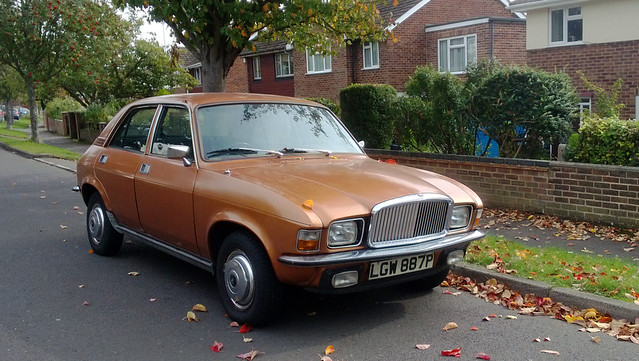
(Image Source: Flickr)
British Leyland began life as a merger between two companies, Leyland Motors and British Motor Holdings, forming the British Leyland Motor Corporation Limited in 1968. The company hit problems some years later and was nationalised by the British Government in 1975, and in 1978 became known as British Leyland. By then, the company was generally referred to as BL, responsible for 40% of the car market in Britain. At the height of its production, the company operated more than forty manufacturing sites across the UK.
Trouble
BL was responsible for producing Land Rovers, Jaguars and Rovers, as well as the Mini. Despite producing such popular vehicles, the company went from one set of troubles to another. Workers at the Cowley Plant regarded themselves as Morris builders and would not assemble Austin badged cars. The company’s name was changed again in 1986 when it became the Rover Group, later the MG Rover Group.
One of the company’s most serious problems was that too many of their cars were very similar in shape and size, e.g. some Austins and Morrises, which meant that in many areas the company was its own competition! The company could not continue in this manner; almost from its inception it had been a company divided against itself, and just like the proverbial houses, it could no longer stand. Even the 1970’s restructuring and government intervention were not able to save the company from itself.
The company finally ceased production of cars in Britain in 2005. Just before going into administration, the group attempted a merger with the Chinese company SAIC, but this did not happen. Once the group did go into administration, Austin, Morris, and Wolseley vehicles were all produced by that company. The company also produced Jaguars, some of the most prized vehicles in the world, but in the mid 1980’s, the merger went sour and the cars were then produced by Jaguar Car Holdings, no longer a part of BL.
The Workers and The Buses
At the height of production, the company employed thousands of workers, and the company’s shortcomings, together with industrial disputes and the 1970’s three day working week not only threatened the company, it meant the loss of all those jobs. The part of the company that became Leyland Truck and Bus was one of the largest UK passenger and commercial vehicle suppliers. The company produced thousands of these vehicles every month, and employed more than 30,000 people.
The End
The number of mergers and the divestment of production of certain vehicles, together with strikes and worker unhappiness, were eventually what brought the Leyland Group to its knees. While it may be easy to point the finger, it could be said that the company just became too big to handle, either by its own directors or via various government interventions. At the height of production, the company was one of those things that made Britain great, but its demise made the country a bit player in an industry where once they had held centre stage.
